

![Far Away [Part 22] – The Raid](https://i3.wp.com/c7c8edde.delivery.rocketcdn.me/wp-content/uploads/Far_Away_featured-1000x600.jpg?ssl=1 "Far Away [Part 22] – The Raid")
Trapped in a deadly mountain pass, the caravan fights for survival as Darius faces his greatest test yet.
Read Part 1 | Part 2 | Part 3 | Part 4 | Part 5 | Part 6 | Part 7 | Part 8 | Part 9 | Part 10 | Part 11 | Part 12 | Part 13 | Part 14 | Part 15 | Part 16 | Part 17 | Part 18 | Part 19 | Part 20 | Part 21
* * *
Empty Eyes
Keep supporting MuslimMatters for the sake of Allah
Alhamdulillah, we’re at over 850 supporters. Help us get to 900 supporters this month. All it takes is a small gift from a reader like you to keep us going, for just $2 / month.
The Prophet (SAW) has taught us the best of deeds are those that done consistently, even if they are small.
Click here to support MuslimMatters with a monthly donation of $2 per month. Set it and collect blessings from Allah (swt) for the khayr you’re supporting without thinking about it.
The pass had narrowed until our caravan stretched into a long column that wound like a great river snake along the curving mountain road. The air was thin and bitingly cold. Longwei, Meilin and I were stationed near the rear of the caravan, beside wagon forty out of fifty. Longwei rode ahead of me, his weathered face grim beneath his fur cap. Meilin was behind, one hand resting near the hilt of her dao, her eyes roaming constantly over the cliffs above.
The front of the caravan was completely out of sight, far ahead and around a bend. Jagged cliffs hemmed us in on both sides, their gray faces pocked with caves and dark fissures that seemed to watch us like empty eyes. We carried our own scents with us: mule sweat, leather, and horse dung.
There was no calling of crows or hawks, no bleating of mountain goats, no adhaan or cooking smoke echoing up the mountainside from a distant village. The world was silent but for the hoofbeats and creaking wagon wheels of our caravan.
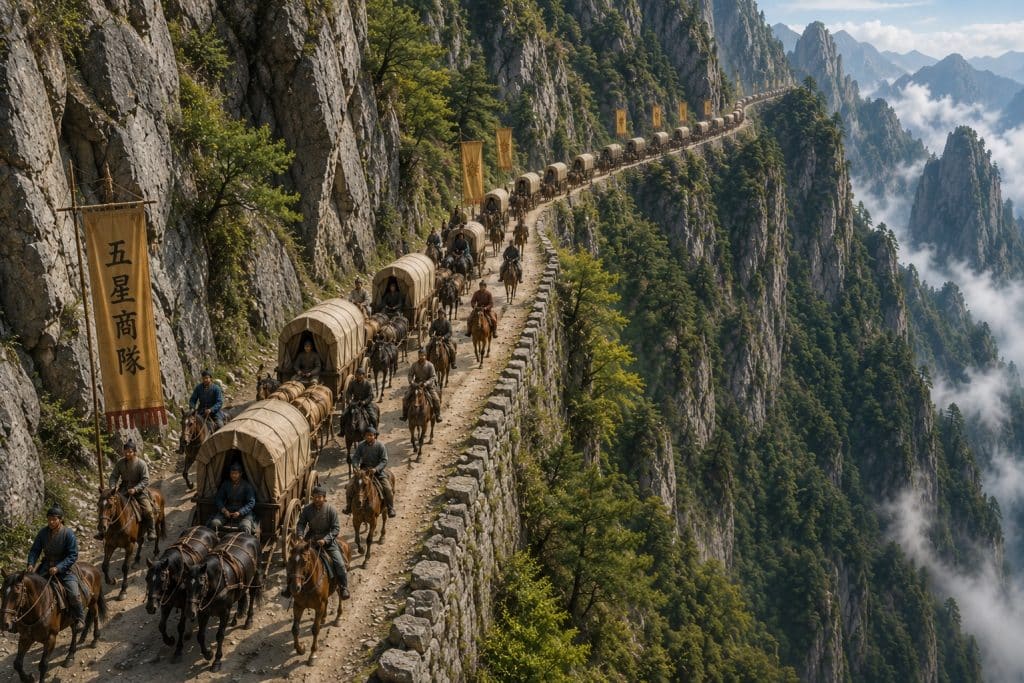
It wasn’t only me who was unsettled. Conversations had lapsed. No laughter sounded. Everyone had their eyes fixed on the caves, as if hordes of demons might pour forth at any moment. Riding easily on Belly’s back – he and I were like one creature at this point, we knew each other so well – I rubbed my hands together vigorously to warm them.
To break the tension, I quietly recited my favorite of Memdooh’s stanzas:
I ride from a northern land
curved sword in my hand.
I’m young but I’m hard
for I’m a caravan guard!
Belly flicked his ears, appreciating the enthusiasm in my voice. Heck, he probably knew the stanza himself by now.
“Boy,” Meilin hissed, “if you recite that poem one more time, you and I will duel again. And I won’t go easy this time.”
I chuckled at this. She’d dislocated my finger and bruised me from head to toe last time, and that was going easy?
Sergeant Karim came toward us, riding slowly along the length of the caravan, studying the heights instead of the road ahead. A brass signal horn hung around his neck, and his face was grim. Every so often he would point with two fingers.
“You. Tighten your helmet.”
“You, fasten that chin strap.”
“Shield on your arm, not your saddle.”
The guards obeyed without question. Men checked sword belts, adjusted bowstrings and settled helmets more firmly upon their heads. One teamster began humming nervously to himself until Karim silenced him with a glance.
“Keep your eyes open,” Karim called. “No one wanders. Stay with your wagons. If the horn sounds, you know your positions.” He continued toward the rear of the caravan.
The merchants instinctively drew closer to their teams. Guards loosened swords in their scabbards and rested their hands upon bow grips. Even the horses seemed to sense the tension. Ears flicked back and forth, nostrils flared, and more than one animal tossed its head uneasily.
Belly gave a low nicker. I reached forward and rubbed his neck. “I know, buddy. We’ll keep each other safe, like we always do.”
“Belly talking to you again?” Meilin asked. “Maybe you can get a bird to scout for us, like Prophet Sulaiman.”
A little later Karim returned from the rear.
The Tea House
“Care for a cup of tea, Sarge?” Meilin joked. This was a reference to the wagon we were guarding, which we colloquially called the Tea House, because it carried a small quantity of jade, several chests of silk and paper, and a great many crates of tea. Riding alongside, the scent of the tea drifted toward me, sweet and pleasant, strangely comforting amid so much unease.
He grinned, knowing that Meilin’s joke did not take away from her attention to her duty. “I’m holding out for Persian chai,” he replied softly. “They make it with saffron, rose and cardamom. No more talking. Listen for my horn.” A moment later, he was gone, moving forward.
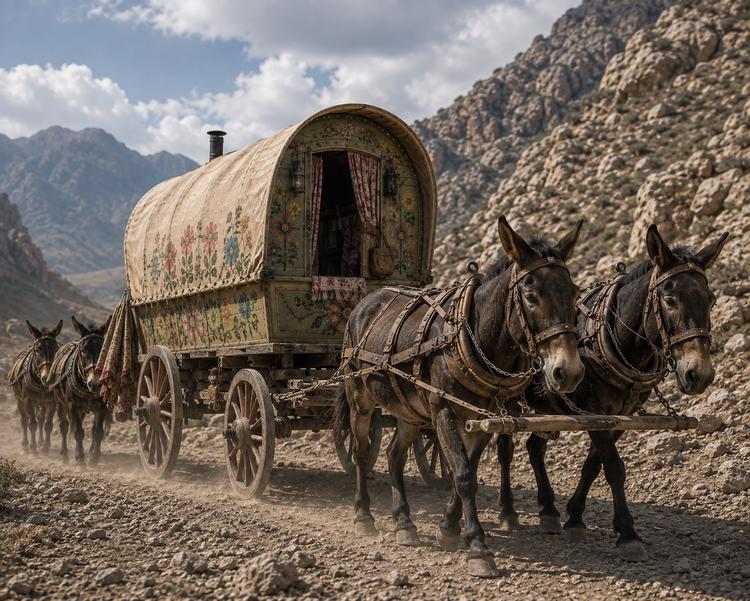
The Tea House was pulled by four mules in tandem, two lead mules and two wheel mules nearest the wagon. The wheel pair supplied most of the braking and steering, while the lead pair provided the extra pulling power needed on steep grades. I had learned all of this on the journey, mostly from Longwei, who seemed to know something about almost everything.
I rode up beside the driver’s bench.
“Cover yourselves with the heavy blankets,” I told the driver and his young apprentice. “And keep a firm hold on the reins. Something’s coming.” I couldn’t have said how I knew this, but I was sure of it. I was discovering that I had good instincts for this kind of thing. My father’s training, perhaps.
The drivers glanced uneasily at the cliffs, then reached beneath the bench and spread thick wool blankets across their shoulders.
As for the two merchants responsible for the Tea House goods, they sometimes rode on horseback alongside their wagon, but today they had chosen to remain inside. Hearing my warning, they hurriedly pulled heavy quilts over themselves and crouched low among the cargo.
I fell back into position. I pushed my helmet more firmly onto my head, tightened the chin strap, and rested one hand on the hilt of my dao. My eyes searched the caves above while my other hand absently rubbed Belly’s neck.
“Steady, boy,” I murmured, and he flicked an ear in acknowledgment.
Cattle Horn
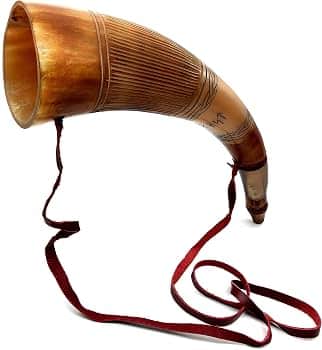
From somewhere far forward and above us came a high-pitched trumpeting sound. It was definitely not Sergeant Karim’s brass horn.
“What is that?” I called out to Longwei.
From the front of the caravan, a horse screamed. The sound was faint but unmistakable.
Now Karim’s horn did sound. One long blast, and one short. The signal for “attack at the front of the caravan.” From behind and around me, guards spurred their horses into a gallop, surging forward. I gave Belly a little kick with my heels as well, but instead of quickening the pace, he stopped dead.
I groaned. “Not now, Belly, please.”
“Darius,” Meilin snapped. “What are you doing? Let’s go.”
I knew that kicking Belly harder would not produce results. Instead I leaned forward to whisper in his ear. Then I froze and cocked my head.
“Wait!” I called out to Longwei and Meilin. Memdooh was riding past, and he paused as well. They circled back to me. Meilin’s face was flushed with excitement, Memdooh’s with what was likely fear, and Longwei looked entirely unfazed.
“What is it?” Longwei demanded. “You heard the signal. Get your damn horse to move.”
“It’s not that. I heard something from the rear. I think they might hit us there.”
Longwei glanced to the rear. There were no guards remaining back there except the six who formed a permanent rear guard, headed by Corporal Jian.
“I see nothing,” he said, but his tone held a note of doubt. “Jian carries a horn as well, he can signal if anything happens.”
I looked up sharply toward the caves at the rear of the caravan. “There it is again.” A cold knot formed in my stomach.
“What?”
“A rock falling.”
Longwei glanced irritably at the cliffs. “We’re in a mountain pass, Darius. Rocks fall. And I didn’t hear anything.”
“Neither did I,” Meilin admitted.
“My hearing is better than yours,” I said quietly.
The sound of fierce fighting drifted to us from the front of the caravan.
“It sounds bad up there!” Memdooh exclaimed. His voice held a note of panic. “We have to get up there or we’ll be whipped for dereliction.”
“I’m telling you,” I said, “an attack is coming at the rear. Those six men will be overrun. And what about the Happy Wagon? Gulnur is alone and defenseless.”
The third wagon from the rear was Kuangren and Gulnur’s matrimonial wagon. Some of the guards had painted flowers on it, and we had come to call it the Happy Wagon. Gulnur had fallen ill to some kind of flu, and was asleep back there. I knew these things because it was my job to know. All of us knew the status and contents of every wagon in our sector.
“How can you know that?” Longwei’s tone was irritated and angry.
“My gut.”
Meilin studied the cliffs above the rear of the caravan. The wind tugged at her hair. Somewhere up front, another scream echoed off the mountains. Finally, she nodded. “I trust the kid. Besides, there are plenty of guards up front. What if something does kick off back here?”
Longwei stared at her for a moment, then muttered a curse beneath his breath. “Wonderful,” he said. “We’ll all be whipped together.”
Rear Attack
Without another word, the four of us turned our horses and started toward the rear. We had not gone fifty paces when another cow horn bellowed from behind the caravan, loud and terrible, echoing through the pass.
Longwei stopped so abruptly that his horse reared. “Damn,” he growled. “The kid was right.”
“Heaven preserve us,” Meilin whispered.
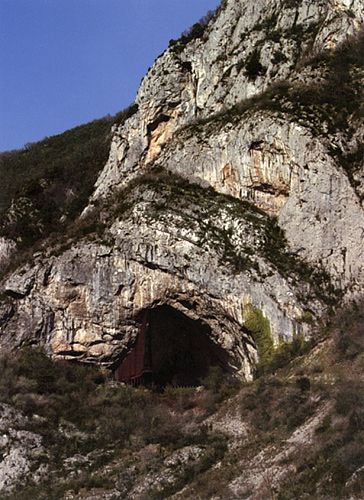
The attack came all at once. Volleys of arrows poured forth from the small caves in the cliff. Corporal Jian toppled from his saddle without a sound. A mule shrieked and collapsed in the road, shafts protruding from its neck.
“Darius,” Longwei said softly, “remind me never to doubt your ears again.”
Men boiled out of the caves like soldier ants. They came on foot with wild cries, bounding like goats down the steep slope, wielding either short lances, or short, curved swords that looked much like my dao.
The four of us charged into the storm.
Three of the rear guards were down now. One of the surviving guards was struggling to free his leg from beneath his fallen mount while the other two fought desperately beside the last wagons.
The attackers numbered at least fifty. They scrambled down the slope in loose groups, shouting in a language I did not understand. Even in the midst of battle, I found myself struck by their appearance. The Afghan men were handsome – tall and lean, with high cheekbones and fierce eyes of blue, green, and amber. Their clothes were patched and faded, their boots worn nearly through. There was something hard and weathered about them, as if the mountains themselves had carved them into what they were.
At the rear of the attackers stood a middle-aged man with streaks of gray in his beard, shouting orders and pointing with his sword. Beside him loomed two enormous bodyguards carrying axes.
As we passed the Happy Wagon, Kuangren and Gulnur both stepped out. I’d thought Kuangren was on duty, but he must have been looking after his wife. He looked ridiculous in a nightshirt with no trousers and leather slippers, yet carried his bow and a fat quiver of arrows. His wife wore a long robe, and despite her pale, sweaty face, she too carried her bow.
From somewhere, Shah appeared. He was a big guard, tall and powerful, with bulging, muscular arms that threatened to tear his sleeves open. He carried a giant broadsword and could bash a man’s skull in even with the flat of the blade. I was happy to see him.
Orders
Longwei took one look at the battlefield. “Wedge formation!” he roared. “Straight through the center! Break them apart!”
My eyes roamed quickly over the battlefield, and I shouted, “No!”
Longwei wheeled toward me, astonished.
“What?”
“Kuangren! Gulnur!” I pointed at the gray-haired elder at the back. “Target the leader! Longwei, Meilin, flank them! Longwei, go right, Meilin, left. Kill the bodyguards, then attack from the rear. Memdooh, find high ground and empty your quiver. Check your lines of sight, don’t hit our men. Shah, you’re with me. We’re going up the middle. I need to get to Jian’s horn.”
For a moment, no one moved.
Longwei stared as if I had lost my mind. “Boy, know your place,” he growled.
Meilin looked from me to the Afghan commander and then back again. “Do as Darius commands!” she shouted. “You have your orders!”
Longwei looked like he’d been stabbed in the back. His eyes darted from Meilin to me, and I saw rage there. But he did not argue. He and Meilin rode in opposite directions, evading the oncoming force, and moving fast.
Trusting the men to do as I’d ordered, I plunged into the battle with Shah at my side. We had a huge advantage because we were mounted and the Afghans were not. Belly was steadfast, obeying the slightest pressure from my knees, and sometimes moving exactly where he needed to without prompting. We were surrounded by the deafening tumult of battle, but for all Belly cared, the noise might as well have been the sighing of the wind through a stand of eucalyptus trees.
Beside me, Shah cut men down as easily as a gardener might prune a thorny tree. He wasn’t even breathing hard, and I heard him chanting, “SubhanAllah wa bihamdihi, SubhanAllah wa bihamdihi, SubhanAllah wa bihamdihi.”
Two Shorts and One Long
A burly, middle-aged Afghan with a tangled beard like a juniper bush swung an axe at my midsection. Axes were much harder to block or parry than swords, and I didn’t try. I pulled Belly back just enough to let the axe swing by, missing me by the width of a pinky finger, then leaned forward and put my dao into his throat. I kicked him off the weapon, slipped an upward jab by a gangly youth of twenty or so, and lopped off his arm.
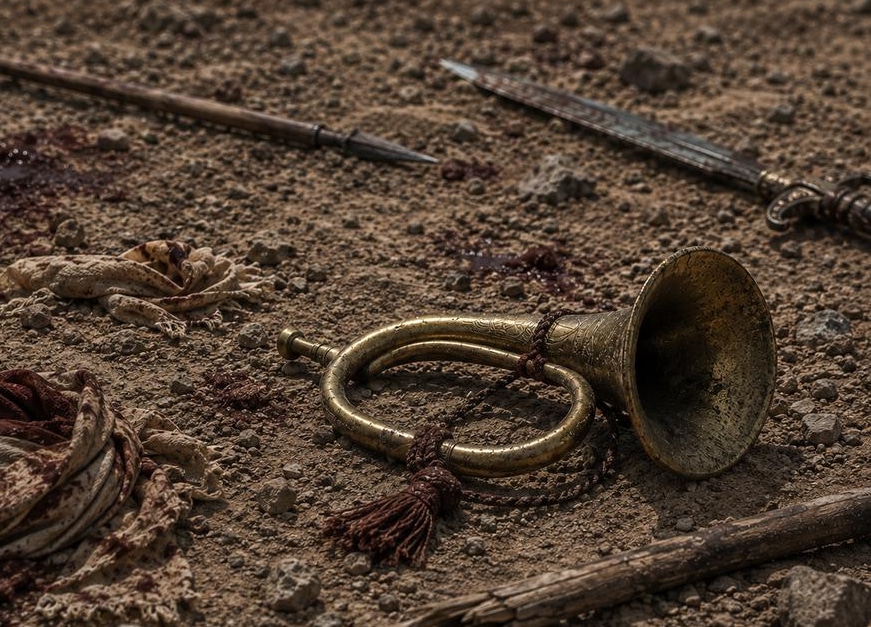
Corporal Jian lay before me. An arrow had pierced his chest. His black eyes stared blankly upward. He’d dropped the brass horn, and his outflung hand stretched toward it, as if he had been about to blow it when he fell, and had been reaching for it until the moment of his death.
I dismounted and closed Jian’s eyes. Then I lifted the horn, raised it to my lips and blew two short blasts and one long. The signal for “attack at the rear of the caravan.”
For just an instant, the fighting seemed to pause all around me, like a dragon taking in a deep breath before blowing fire. Some of the Afghans uttered what could only have been curses. Then the dragon blew, and the fighting resumed.
Unfortunately I’d drawn attention to myself. A half dozen arrows winged my way. I dropped to the ground, snatched up a fallen shield and covered my head and neck. Most of the arrows missed. One bounced off the shield. But one pierced my left calf. I cried out in pain but there was no time to worry about it. A shadow loomed behind me and I turned a split second too late as a big Afghan came charging at me with a lance in one hand and a sword in the other. An instant before he reached me, an arrow entered his neck, and he crashed to the ground beside me. I looked around and saw Memdooh, standing atop a boulder, another arrow already nocked into his bow. He was pale and clearly terrified, but he grinned at me, and I grinned back. He’d saved my life.
Again, just to be sure, I raised the horn. This time I took a deep breath and blew as hard as I could. Two short, one long. Then I hung the horn around my neck, leaped back onto Belly’s back, lifted my dao and plunged into the fight.
A Belly Bite
A hand seized my boot and yanked.
I pitched sideways in the saddle, suddenly looking down into the furious face of a blue-eyed Afghan who was trying to drag me to the ground. I twisted, bringing my dao around, but before I could strike, Belly wheeled sharply and sank his teeth into the man’s shoulder.
The Afghan screamed. Belly shook him once, violently, like a dog worrying a rat, then flung him backward.
“Good boy!” I shouted. “You gave him a Belly bite!”
Belly pinned his ears and surged forward, apparently outraged that anyone had tried to steal his rider.
Men came at me from every direction. I did not kill everyone I faced. A man thrust a lance at me, and I parried the lance and slid my dao up the shaft to his hand, slicing his hand neatly in two. He screamed and dropped the lance as blood fountained from the hand. But he would live. I parried a sword stroke, slashed the attacker across the chest, then ducked as a lance passed over my head. An arrow whispered past my face, and I felt a hot sting along my cheek, followed by sudden wetness. When I touched my face, my fingers came away bloody. The arrow had only grazed me. But there was no time to be relieved.
My Muslim Brother
A young Afghan came through the press directly toward me. He was perhaps twenty years old, tall and lean, with fierce hazel eyes beneath a dark turban. His cheeks were sharp, his beard only beginning to fill in. He raised his curved sword to strike and shouted, “Allahu Akbar!”
Simultaneously, I lifted my dao to block and cried the same words: “Allahu Akbar!”
I froze.
Of course I knew the Afghans were Muslims. I had heard the adhaan in their villages. I had prayed beside them, eaten their bread and listened to their imams recite Quran. Yet until that moment, the men attacking us had existed in my mind only as raiders.
This man is my brother, I thought. My Muslim brother. The thought hit me like a stone from a catapult. He was a young man who performed his salat just as I did. Who bowed toward the same qiblah. Who perhaps had a mother waiting for him in one of these mountain villages, or a wife who had packed food into his satchel before he left.
Panic rose in my throat like bile. How could I kill him? A hadith of the Prophet, one I had learned from Ahmed, rang in my mind: “Insulting a Muslim is wickedness, and fighting him is kufr.”
Kufr! I could not fight this man. I could not kill these people. The young man lunged at my midsection. I barely twisted aside in time. His blade passed so close that it scraped the leather of my belt.
“Wait!” I shouted, but he paid no attention. “As-salamu alaykum!” I tried. Yet the man brought his sword down toward my head. I raised my dao into an umbrella block. Steel crashed against steel above my head, the impact jolting through my shoulders.
I did not counter. I could not bring myself to. My eyes darted from side to side, searching for some route of escape. Men fought all around us. Horses screamed. Dust filled the air. There was nowhere to go.
Was there a chance the man spoke Uzbek? “Aka!” I cried. The Uzbek word for brother. Yet the Afghan attacked again, anger and confusion in his hazel eyes. Perhaps he could not understand why I refused to strike. His sword swept toward my ribs.
I leaned away and parried late. The edge sliced through my coat without touching flesh.
He recovered instantly and raised the weapon for another blow.
I had no choice. Sooner or later one of his blows would get through. I feinted toward his head. When he lifted his sword to meet the false attack, I changed direction and drove the point of my dao into his chest.
His eyes widened.
For one terrible moment we stared at each other. The man’s mouth opened, but only a wet breath escaped. Then his sword fell from his hand, and he collapsed beneath Belly’s hooves.
Tears spilled from my eyes. If the man did indeed have a wife waiting for him back home, she would find only bitterness returning. Why had he made me do that? I wanted to climb down, kneel beside him and somehow undo what I had done. But even at my young age I knew that death is the one thing that cannot be undone. You can apologize to a man for insulting him. You can make restitution for hurting him. But death is a road that enters a dark cave and disappears from view. When you kill a man, you take away everything he will ever have.
The Retreat
Life, on the other hand, is a sea that at times lifts you up, and at other times crashes down upon you, and you either swim or drown. Another Afghan rushed me, and I cut his belly open. He might survive with help. A second came from my left, and I struck him across the temple with the guard of my dao, knocking him out. A third threw his axe at me, and I ducked it. It was as if half of the attacking force had suddenly decided that I was the main obstacle between them and success. Another man swung a sword at my leg. I blocked it and sliced upward. He leaned back but the tip of my sword caught his chin, cleaving it in two.
As quickly as the wave slammed into me, it receded. The fighting had become scattered. The Afghans were no longer advancing. A few continued to press, while others glanced behind them or began backing toward the caves.
“The commander is dead!” Longwei shouted. “Their commander is dead!”
I looked toward the rear of their force. Longwei and Meilin stood near the gray-bearded leader’s body. One of the hulking guards lay facedown nearby, an axe still gripped in one hand. The other was sprawled on his back with Meilin’s dao buried in his chest. As I watched, she put a foot on his chest and pulled it out.
A shudder seemed to pass through the attackers. Then they broke and ran.
Some fled up the slope toward the caves. Others ran down the road or leaped among the boulders, abandoning weapons and wounded comrades. The surviving guards cried out in triumph and started after them.
A Wagon
“They have a wagon!” someone shouted.
I turned.
A narrow trail branched from the main road behind the last wagon, descending steeply between two walls of stone. I had not noticed it before. Four horses were pulling one of our covered wagons down the trail at a reckless pace, the wheels bucking and bouncing over the uneven ground. Afghan men ran beside it, perhaps twenty of them, pushing at the rear and clinging to its sides.
The trail led directly toward the mouth of a great cave.
For a heartbeat I could only stare.
Then I looked around me, trying to understand what remained of the battle.
Perhaps thirty Afghans lay dead or wounded along the road and among the rocks. I was personally responsible for maybe ten of them. Several of our own guards were down as well. Longwei and Meilin – both breathing heavily, their clothing streaked with blood – stood over the bodies of the commander and his bodyguards. One side of Longwei’s face was purple with bruises. Meilin’s hair had come loose, one sleeve had been torn away, and one arm hung uselessly at her side, probably broken.
Memdooh lay curled beside the boulder from which he had been shooting. He clutched one leg while moaning through gritted teeth. A short sword lay near his hand, its blade red. He had fought even after he ran out of arrows. He had held his ground.
Gulnur lay on the ground beside the Happy Wagon.
Kuangren knelt over his wife in his nightshirt and slippers, his bow forgotten in the dust. He had gathered her into his arms and was rocking her, pressing his face against her hair. I could not tell whether she was conscious. Her robe was stained with blood.
Shah alone appeared untouched. The giant stood amid the bodies with his enormous sword resting against one shoulder, breathing as calmly as if he had merely finished chopping wood.
What to Do?
Men were looking at me. I still wore Corporal Jian’s horn around my neck. I had given the orders. Now the rear guards, the merchants, even some of the teamsters watched me, waiting to be told what to do next.
I had no idea.
Should we pursue the wagon? Tend the wounded? Secure the remaining wagons? Send men into the caves? The enemy was fleeing, but they might be drawing us into another ambush. Memdooh needed help. Gulnur might be dying. The surviving Afghans could regroup at any moment.
My thoughts collided uselessly in my head.
Then hoofbeats thundered up the pass. Sergeant Karim came charging around the bend at the head of a mass of mounted guards. Among them was Weili, her bow at the ready. Dust rolled behind them like smoke. Karim’s sword was red with blood, his armor dented, and the brass horn bounced against his chest as he rode.
Relief flooded through me so strongly that my knees nearly gave way.
River Flow
The sergeant reined in so hard that his horse skidded sideways in the dust. He took in the scene in a single sweep: the dead Afghans scattered across the road, Longwei and Meilin standing over the bodies of the commander and his guards, the wagon careening toward the cave, the horn hanging from my neck, and the men looking to me for orders.
His gaze settled on me.
“Recommendation?”
For a moment, I simply stared at him. My left calf felt as though someone had thrust a hot poker into it and left it there. Blood soaked my boot. My cheek burned where the arrow had grazed me. The world tilted strangely, and I swayed in the saddle.
Recommendation? Was he insane? I was sixteen years old. Half the men around us had gray in their beards. Sergeant Karim himself had fought in a dozen battles before I’d ever picked up a sword. Why was he asking me?
Then something happened inside me. The panic and pain vanished, and everything slowed. The screams, the dust, the clashing steel, the cries of the wounded – all of it receded into the distance. My mind became perfectly still, as clear as a summer sky. For the first time that day, I fell into River Flow.
From my perch atop Belly’s back, I pointed with my dao.
“Archers! Target the men running beside the wagon, not the horses! Weili, take the driver! Someone find Arslan! Get him here now!” Yes, I knew Arslan was a man with a problem. And he’d seduced Weili away from me. But he was the only man capable of bringing the wagon driver down at long range, and that was all that mattered.
“Shah and I will pursue the wagon,” Longwei called.
I turned to Karim. “I don’t know if you want that.”
“Do you want that?”
Entrusting me with such decisions was ridiculous, but – still in River Flow – I went with it.
“No pursuit!” I shouted. “Archers only. No one leaves the road.”
Karim nodded once, as if everything I had said were entirely reasonable. “Move!” he roared.
The surviving archers hurried into position. Memdooh, still lying beside the boulder, struggled upright and reached for his bow with trembling hands. I grinned fiercely at that. Courage was not a battle-hardened warrior who killed without emotion. Courage was this wounded young man, climbing to his feet to carry out his commander’s wishes. He might not be much of a poet, but he had the heart of a lion. Allah protect and preserve him.
Weili vaulted onto a rock overlooking the trail and drew an arrow from her quiver.
The wagon was perhaps two hundred paces from the cave.
Their Dirty Secret
“Loose!” Karim shouted.
Arrows hissed through the air. One of the Afghans running beside the wagon spun and collapsed. Another pitched forward beneath the wheels. A third cried out and clutched his thigh. But the others kept running, pushing at the wagon and shouting to one another. Weili, tasked with shooting the driver, missed, her shot going wide. It should have been an easy shot. I’d seen her shoot better on her worst day.
“Again!” I shouted. “Fire at will!”
A second volley flew, and a third. Another three men fell. The driver still sat hunched on the bench, lashing the horses onward.
Weili drew, exhaled, and released. Her arrow sailed wide, striking the rocks behind the wagon. She nocked another arrow, drew farther this time, and released. Again she missed. The wagon pulled farther away every second. It would soon be out of range.
“Where is Arslan?” Karim bellowed.
“I’m here!” Arslan arrived disheveled and panting, his hair plastered to his forehead with sweat. He looked as if he had run half the length of the caravan. He carried his massive bow in one hand.
Karim pointed furiously at the fleeing wagon. “The driver! Bring him down!”
Arslan lifted his huge bow and pulled, but I saw that his arm trembled, and he was not able to draw the arrow all the way back to his cheek. He loosed, and the arrow fell short. He cursed, grabbed another arrow and shot again. This one fell short as well.
The wagon was almost at the cave now.
Longwei spurred his horse forward. “Sarge, let me pursue. We can still catch them!”
“No!” Karim roared.
Longwei wheeled back in disbelief. “Why?”
Karim pointed toward the yawning cave. “There could be a hundred men in there. We will not risk any more guards for one wagon. Darius already gave a command on this.”
“Darius,” Longwei muttered, and spit. No one else argued, and we watched helplessly as the last of the Afghans disappeared into the darkness. The wagon vanished after them, swallowed whole by the mountain.
For a long moment, no one spoke. Karim’s eyes moved from Weili to Arslan, then to me.
I knew why they had failed. I knew their dirty secret. But I said nothing about that. Instead I said, “If anyone is to be whipped for disobeying orders it should be me. It was my call to move to the rear.”
This Is War
“We’ll talk about that later,” Karim said. “What’s next?”
I swallowed, then called out. “Medics! See to the wounded. Our wounded first, then the Afghans.”
“Almost right,” Karim said. He called the chief medic over. “Our wounded only. Do not touch the Afghans.”
“But they’re Muslims,” I said.
He studied me. There was a newfound respect in his gaze. He didn’t seem angry about the loss of the wagon. Some part of me realized that none of this was new to him. He’d done all this many times.
“I’m no religious expert,” Karim said, “but being Muslim doesn’t mean we sacrifice our lives to their greed. We have limited medical supplies, and a caravan to protect. We will be on the move very soon. The Afghans can return for their own dead and wounded. This is war.”
He began to give orders to load our dead onto the wagons. I realized that by “very soon” he meant right now. He meant to get the caravan moving again immediately.
It was becoming harder to think. The crystal clarity of River Flow faded, and the pain rushed back into my body. My calf felt as though it were on fire, and my cheek too felt hot, as if I’d been slapped very hard.
Someone was saying my name. I looked down. At some point the shaft of the arrow had broken off – I hadn’t even noticed – but the arrowhead was still in my leg. Blood streamed from the wound and ran down Belly’s side. The mountains spun around me, and I swayed in the saddle. The dao slipped from my fingers, and I felt myself falling.
* * *
Come back next week for Part 23 – Delirium
Reader comments and constructive criticism are important to me, so please comment!
See the Story Index for Wael Abdelgawad’s other stories on this website.

Wael Abdelgawad’s novels – including Pieces of a Dream, The Repeaters and Zaid Karim Private Investigator – are available in ebook and print form on his author page at Amazon.com.
Related:
Pieces of a Dream | Part 1: The Cabbie and the Muslim Woman
Trust Fund And A Yellow Lamborghini: A Short Story


![Far Away [Part 23] – Delirium](https://i3.wp.com/c7c8edde.delivery.rocketcdn.me/wp-content/uploads/Far_Away_featured-1000x600.jpg?w=336&resize=336,220&ssl=1)

