


The second American-Israeli attack on Iran in as many years has killed Iran’s longstanding ruler, Ali Khamenei, and triggered a wave of escalation that has rattled across the region as Oman-brokered negotiations with Tehran were dramatically sabotaged by the United States and Israel. Khamenei, Iran’s paramount ruler since 1989, was the seniormost of a smorgasbord of Iranian leaders killed in the original American-Israeli attacks, which also wrought devastation in other Iranian cities. In turn, Iran not only launched missiles at Israel but also at the nearby Arab Gulf states, several of which host the American regional command.
A Sweep of Iranian Leadership
In his late eighties when he was killed, Khamenei (1989-2026) had been an eminence grise of Iranian politics for almost fifty years. Even before replacing the clerical republic’s founder, Rohollah Khomeini, as “supreme leader”, a paramount position symbolically similar to but far more active than that of a constitutional monarch, he had served in the Iranian presidency as a key figure between the Iranian military, praetorian, and political leadership. He sat at the apex of the Iranian hybrid democracy that held a cleric as executive over an elected presidency.
Killed along with Khamenei, and reportedly his infant granddaughter, were defence minister Aziz Nasirzadeh as well as military commanders Abdol-Rahim Mousavi and Mohammad Pakpour, who had both taken up their roles after their predecessors had been killed in the summer 2025 American-Israeli attacks on Iran. Also killed was a former Iranian president, Mahmoud Ahmadinejad, long a favoured bane of the Americans and Israelis when he held the presidency in 2005-13, and former defence minister Ali Shamkhani, who had led negotiations before they were sabotaged by the United States in 2025. Shamkhani had first been reported killed in the summer 2025 American-Israeli attack, but on this occasion, his death was confirmed.
Keep supporting MuslimMatters for the sake of Allah
Alhamdulillah, we’re at over 850 supporters. Help us get to 900 supporters this month. All it takes is a small gift from a reader like you to keep us going, for just $2 / month.
The Prophet (SAW) has taught us the best of deeds are those that done consistently, even if they are small.
Click here to support MuslimMatters with a monthly donation of $2 per month. Set it and collect blessings from Allah (swt) for the khayr you’re supporting without thinking about it.
An emergency triumvirate has been installed to lead Iran after Khamenei’s assassination; it includes the presidency’s incumbent, Masoud Pezeshkian, as well as chief justice Gholam-Hossein Mohseni, and the cleric Ali-Reza Arafi. Their immediate task will be not only military reorganization but also the reconstruction of an Iranian polity that is clearly being willed by its “liberators” for a collapse.
A Long-Threatened War
American ruler Donald Trump’s longstanding promises not to launch the United States into foreign wars notwithstanding, Washington and its Israeli partner Benjamin Netanyahu-Mileikowsky had made no secret of their intentions. Netanyahu, and most Israeli leaders besides, have long been taught to urge the United States into a war with Iran; the Israeli prime minister gloated in the aftermath of the attack that he had worked toward this moment for forty years. The attacks of summer 2025, which had similarly sabotaged ongoing negotiations and killed a swathe of Iranian leaders, were evidently unsatisfactory for Tel Aviv despite Trump’s boasts of having destroyed Iranian nuclear capability, and a second round had long since been urged among pro-Israel circles. The partial exposure of an enormous paedophilic ring involving much of the American elite around Israel’s favoured oligarchs, Ghislaine Maxwell – daughter of a British-Israeli tycoon and spy who had helped found Israel in 1948 – and Jeffrey Epstein gives one clue as to the sorts of methods these circles used to embroil an often game American political elite.
In this context, what is more surprising than the outcome was Iran’s reaction and the expectation of good-faith negotiations over its nuclear energy; after all, Trump had consistently taken a maximalist line. Oman, which has often served as a broker, dispatched foreign minister Badr Busaidi to manage the talks, and so optimistic was he that he publicly portended a deal to American media just hours before the American-Israeli attack began.
Regional Backlash
The killing of Khamenei in particular caused outrage because of his position as head of Iran’s state, the longstanding convention since antiquity being not to kill such leaders, but also because he was a figure revered by many Shias, even those not particularly sympathetic to the Iranian regime. As with other Iranian leaders killed during Trump’s stints over the 2020s, he was immediately treated as a martyr. In Pakistan, which is itself warring with Afghanistan, protesters attacked American diplomatic sites and several dozen were killed.
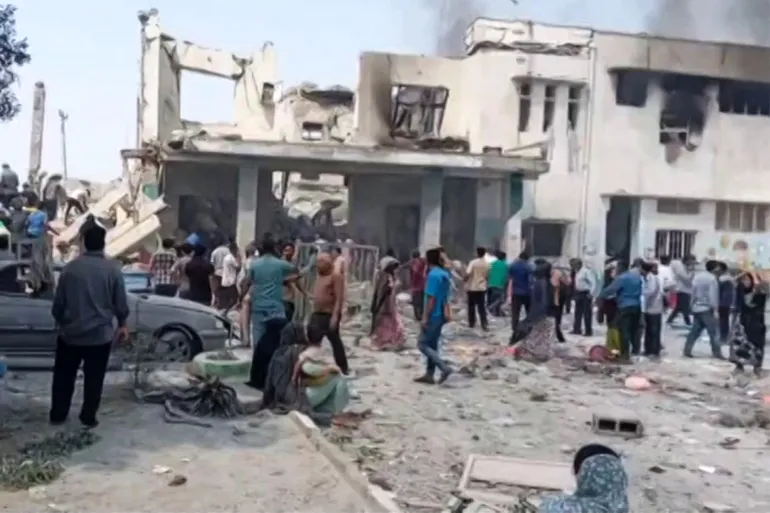
This image grab taken from Iranian state television broadcast on February 28, 2026, shows what it says is the site of deadly US and Israeli strikes that hit a girls’ elementary school in Minab, in the southern Iranian province of Hormozgan near the strategic sea route of the Strait of Hormuz [Screen grab/IRIB TV via AFP]
There was also outrage at the destruction of a girl’s school in southern Iran, where some hundred and fifty people, mostly schoolgirls, were killed. Given the clear capability for precision that the attackers enjoyed and the longstanding record of targeting civilians that Israel, in particular, has perfected, denials lacked credibility. Indeed Emily Schrader, a former “expert” on Iran who has long doubled as a cheerleader of Israeli warfare, acknowledged the attack but justified it on account of alleged military officers in the region: a justification that will be familiar to observers of Israel’s genocide in Gaza, where countless civilians have been massacred under invariably false claims of militant camps in, for instance, schools, hospitals, and mosques.
This was, of course, not the only falsehood on which American-Israeli warfare has rested. In line with exiled monarchists seeking to promote Reza Pahlavi II, the attack claimed to liberate Iran after a supposedly genocidal massacre of protesters over the winter. Though there were indeed protests, partly including but also partly beyond monarchists, that were violently crushed, American-Israeli misinformation has routinely tossed out absurd numbers such as “forty thousand deaths” for a crackdown, conducted with small firearms, that lasted about a week and of which scant evidence exists at all. This is all the more ironic given the drastic undercount of the ongoing genocide by the same Israeli state in Gaza, where footage, names, and ages of victims were readily available but repeatedly dismissed.
On that note, Israel took the opportunity of escalation to once more impose a full blockade on the Gaza Strip, thus ending whatever impressions remained of Trump’s unconvincing charade of a peace deal. There had been no ceasefire, of course; though Israeli airstrikes had somewhat decreased in number, at least six hundred Palestinians have still been killed since the ceasefire. The imposition of a total blockade under demonstrably false pretexts – Israel claiming that Gaza now had a surplus of food, while independent observers noted that over seventy per cent of the supposed food distribution had been barred – put a nail in the coffin of the “ceasefire”.
Iran’s own predictable response has been reciprocation with missiles at Israel, but more controversially, to attack the Arab sheikhdoms of the Gulf. Though several of these host American military presences, they have also, in general, sought to mediate. Qatar, for instance, hosts the region’s largest American base, but has consistently called against escalation and was attacked by Israel during its mediation attempts in autumn 2025, with almost certain American foreknowledge. Now, the other side of the negotiations, Tehran, has also launched attacks on it. In Kuwait, an attempt to shoot down Iranian aircraft instead accidentally downed American warplanes.
In other countries, especially those that pioneered normalization with Israel, the reaction to Iranian strikes was more sanguine. There was some celebration of Iranian strikes in Bahrain, a Shia-majority country under a repressive minoritarian monarchy. And there has been some schadenfreude at the mass flight of foreigners from the United Arab Emirates, which has long marketed itself as a beacon of regional peace while attracting right-wing oligarchs, whipping up campaigns against Muslim diasporas, and subverting a smorgasbord of regional countries from Sudan and Somalia to Saudi Arabia and Libya.
In the final balance, however, as in most wars, it is not nefarious elites who will be exposed to the greatest danger. What is unusual about the Iranian case, though in common with other governments that Israel and the United States have attacked in recent years, is the number of top-ranked leaders that have been killed, and the fact that Iran’s strategic location overlooking the Gulf and the pathway to south-central Asia makes its collapse all the more dangerous.
Related:
– Genocidal Israel Escalates With Assault On Iran
– Iran President Ebrahim Raisi’s Controversial Career Ends In A Helicopter Crash


