


Ziyad Motala, Professor of Law, Howard Law School
A Troubling Spectacle
A troubling spectacle continues during the nightly prayers of Ramadhan. In Islam’s holiest mosques, supplications lavish praise upon the Saudi ruler, Mohammed bin Salman, and seek divine favour for the strength and victory of the Saudi state and its security forces. Millions of Muslims around the world instinctively respond with “Aameen.” They believe they are participating in devotion. In reality, many are unknowingly affirming prayers that sanctify the ambitions of the Saudi state and its ruler at a moment when that state stands aligned with powers devastating Muslim lands.
The Meaning and Purpose of the Qunoot
Each evening in the month of Ramadan, millions of Muslims stand in prayer during the final phase of the nightly prayer, known as the Witr. In that moment, the imam recites what is called the Qunoot. The word simply means supplication. The imam raises his hands and implores God for mercy, forgiveness, and protection for the community. The congregation responds with a soft but collective “Aameen,” affirming the prayer and making its contents their own. It is a moment meant to embody humility before the Divine. In principle, it is among the most moving practices in the Muslim devotional life. It reminds believers that all authority, all power, and all protection ultimately belong to God alone.
When Supplication Becomes Political Theatre
Keep supporting MuslimMatters for the sake of Allah
Alhamdulillah, we’re at over 850 supporters. Help us get to 900 supporters this month. All it takes is a small gift from a reader like you to keep us going, for just $2 / month.
The Prophet (SAW) has taught us the best of deeds are those that done consistently, even if they are small.
Click here to support MuslimMatters with a monthly donation of $2 per month. Set it and collect blessings from Allah (swt) for the khayr you’re supporting without thinking about it.
But segments of the Qunoot have become political theatre. Certain court clerics have transformed the Qunoot into a peculiar spectacle of political flattery. Their supplications have included prayers not only for the Muslim ummah, but for the well-being of the Saudi state and the personal success and triumph of the Saudi rulers. More striking still is the language in which these prayers have been framed. The ruler has been addressed with honorifics such as “Al Amin,” a title intimately associated with the Prophet Muhammad P.B.U.H. himself.
Words shape the moral imagination of believers. In the Islamic tradition, the Prophet was known as Al Amin, the trustworthy, a designation earned through a life of moral credibility long before prophethood was proclaimed. To attach that title to a modern prince presiding over a state of debauchery, spectacle, repression, and geopolitical intrigue where Muslims are being massacred is grotesque clerical flattery bordering on parody. And when millions of Muslims dutifully respond with “Aameen,” they are unknowingly affirming not just devotion but the spectacle itself. They are giving their assent to this sycophancy offered in the language of prayer.
What are Worshippers Affirming?
The supplications have continued with appeals that God strengthen the rulers, grant them victory, empower the Saudi security forces, and preserve the Saudi state from every evil. The congregation of over two million responds with “Aameen.” For countless worshippers, the Arabic phrases are not fully understood. They are participating in an act of devotion and assume that the words being recited reflect the moral spirit of the tradition.
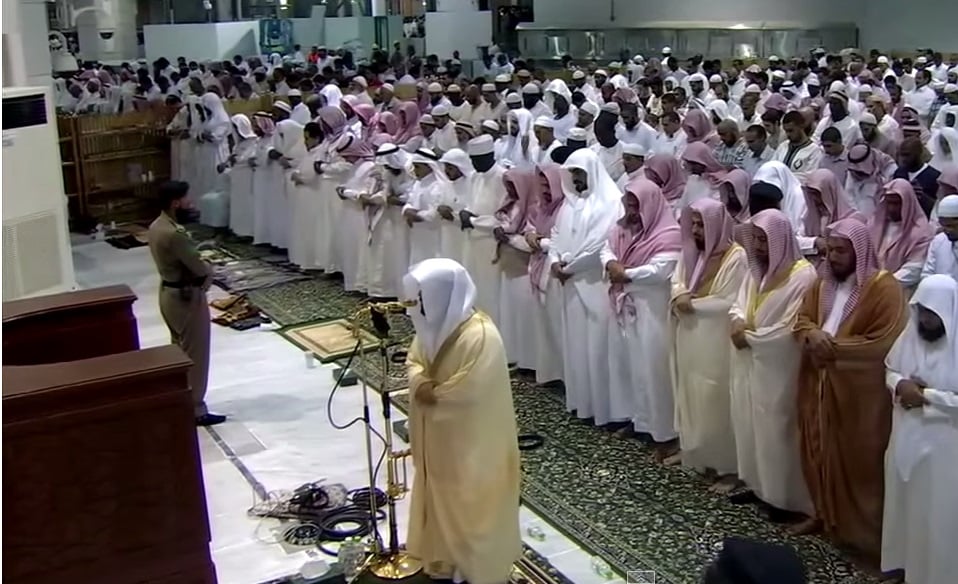
What exactly, then, are Muslims affirming when they say “Aameen”? The modern Saudi state is not an Islamic state. It is a nation state whose ruling order did not arise from Islamic legitimacy but was forged under British patronage and sustained by Western, particularly United States, power. This state claims custodianship of Islam’s holiest places while aligning itself closely with the strategic priorities of the United States and Israel, powers actively engaged in war against Muslims. At the same time, the world watches the devastation of Gaza and the steady seizure of Palestinian land, realities unfolding alongside the strategic partnership linking Saudi Arabia, the United States, and Israel.
Contradictions in Policy and Practice
One hears supplications for the protection of Muslim lands and the strengthening of the faith, while the political alliances of the state reciting those prayers sit comfortably beside the very forces that are devastating Muslim societies. The dissonance is difficult to ignore. Saudi Arabia’s recent trajectory only sharpens the paradox. The kingdom presents itself as the guardian of Islamic orthodoxy, yet it has simultaneously cultivated a political order increasingly defined by grotesque spectacle, wealth, and strategic alignment with Western power. Its rulers preside over a social transformation built around lewd entertainment and luxury while imprisoning scholars whose religious authority might challenge the state. Clerics who dissent disappear into prisons, while clerics who praise the ruler appear on the pulpits of the two holy mosques.
Beyond its borders, the kingdom’s political footprint is equally troubling. Its war in Yemen produced one of the most severe humanitarian catastrophes of the modern era. Its interventions in the politics of Egypt and elsewhere have strengthened authoritarian rule across the Arab world. It has historically encouraged a regional confrontation with Iran, whose consequences now threaten to engulf the entire Middle East. Against this background, the Qunoot sounds less like supplication and more like state messaging delivered through sacred ritual.
Power, Image, and Religious Authority
There is another irony. Mohammed bin Salman is frequently presented, by admirers and critics alike, as though he were a central figure representing the Islamic world. He is not. He is the ruler of a modern nation state that bears the name of his own family. The very designation “Saudi Arabia” is a historical anomaly. The Prophet Muhammad, may Allah give him peace and blessings, did not name Arabia after himself. Nor did the Rightly Guided Caliphs transform the lands of Islam into dynastic brands. Their authority rested on moral example and communal legitimacy. The modern Saudi state rests on oil wealth, security alliances, and the imposition of a ruling family whose name defines the country itself. To call the Saudi ruler “Al Amin” is theological absurdity.
The Weight of Saying “Aameen”
Yet through the symbolism of Mecca and Medina, the Saudi state possesses a unique capacity to project its voice into the devotional life of Muslims everywhere. When the imam in the Grand Mosque raises his hands in supplication, believers instinctively respond “Aameen.” But prayer is not passive. To say “Aameen” is to affirm the words that have been spoken. Muslims, therefore, confront a quiet but profound question. When the Qunoot asks God to grant victory to illegitimate rulers whose policies align them with all kinds of debauchery and vice, the bombardment of Gaza, the dispossession of Palestinians, and the escalation of war against Iran, should believers reflexively echo that prayer?
There is an even more basic issue. Muslims should not be saying “Aameen” to supplications that ask God to strengthen the nation state of Saudi Arabia or its ruler. Saudi Arabia is not an Islamic state. It is a nation state organised around a ruling family and structured primarily to protect the interests of its political and economic elite. The global Muslim community does not owe devotional affirmation to the success of such a state.
Lessons From Islamic Tradition
Islamic history contains many examples of scholars who refused to sanctify temporal power. Imam Ahmad ibn Hanbal endured imprisonment rather than submitting to doctrines imposed by the Abbasid state. Jurists across centuries insisted that religion must restrain rulers rather than ornament their authority. Those precedents were not acts of rebellion. They were acts of fidelity.
Preserving the Integrity of Worship
The Qunoot is meant to remind believers of their dependence on God. It is not meant to consecrate the ambitions of princes. When the language of supplication becomes indistinguishable from the language of court praise, the prayer itself loses its moral clarity. Ramadhan is a season of spiritual awakening. It is also a season of moral reflection. The lesson for Muslims is simple but urgent. Devotion must never become a vehicle for the sanctification of power.
And before saying “Aameen,” a believer should always know what they are agreeing to. For in matters of faith, an unthinking “Aameen” can become the quietest form of political consent.
This article is an opinion piece and reflects the views of the author, not necessarily those of MuslimMatters.
Related:
Freedom Of Speech And Protest In Islam: The Distorted Saudi View
What Shaykh Muhammad Al Shareef Taught Us About Making Dua


